- Mechanisms for AR/VR/xR
Force Feedback in Mixed Reality Experiences through Electrical Muscle Stimulation
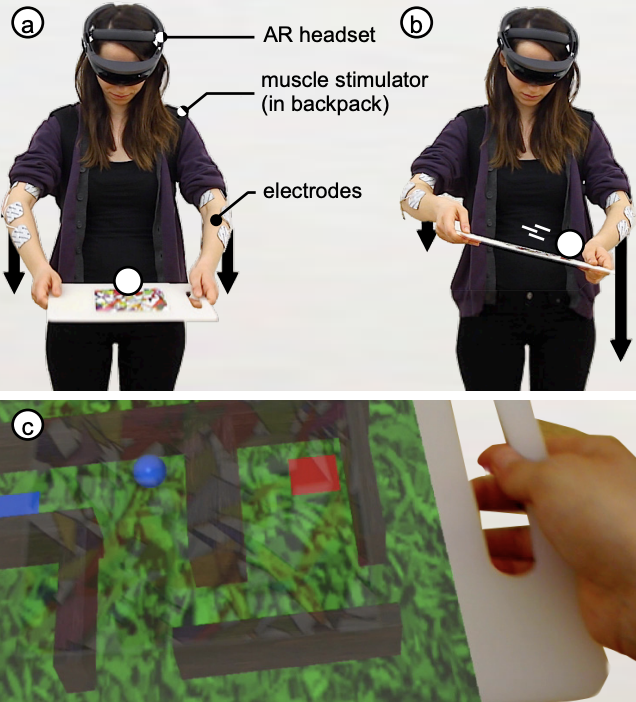
Shows a participant using the syystem. (a) In this Mixed Reality game that uses a physical tray as prop, our mobile system renders shifts in the tray’s center of gravity as the marble moves. (b) Our system creates the necessary forces by applying electrical muscle stimulation to users’ triceps muscles. (c) Our approach leaves users’ hands-free at all times, allowing the user to interact with the tray.

Shows a participant using the syystem. (a) In this Mixed Reality game that uses a physical tray as prop, our mobile system renders shifts in the tray’s center of gravity as the marble moves. (b) Our system creates the necessary forces by applying electrical muscle stimulation to users’ triceps muscles. (c) Our approach leaves users’ hands-free at all times, allowing the user to interact with the tray.
Description
A mobile system that enhances mixed reality experiences and games with force feedback by means of electrical muscle stimulation (EMS). The benefit of this approach is that it adds physical forces while keeping the users’ hands-free to interact unencumbered—not only with virtual objects but also with physical objects, such as props and appliances that are an integral part of both virtual and real worlds. This study demonstrates how this supports three classes of applications along the mixed-reality continuum:
(1) entirely virtual objects, such as furniture with EMS friction when pushed or an EMS-based catapult game. (2) Virtual objects augmented via passive props with EMSconstraints, such as a light control panel made tangible by means of a physical cup or a balance-the-marble game with an actuated tray. (3) Augmented appliances with virtual behaviors, such as a physical thermostat dial with EMS detents or an escape-room that repurposes lamps as levers with detents.
Website(s)
Bibliography
Lopes, P., You, S., Ion, A., & Baudisch, P. (2018, April). Adding force feedback to mixed reality experiences and games using electrical muscle stimulation. In Proceedings of the 2018 chi conference on human factors in computing systems (pp. 1-13).