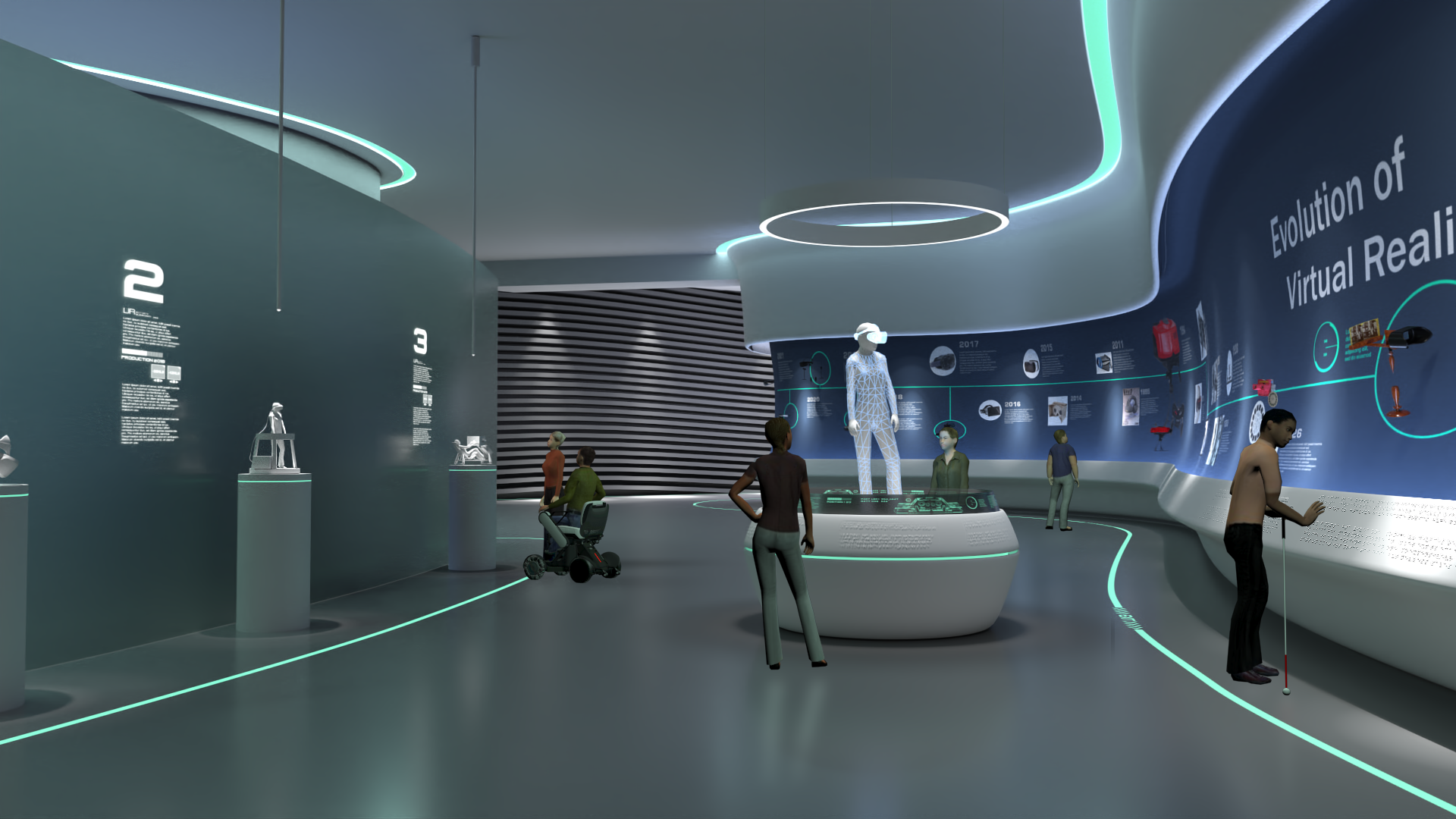
- what is Seen
Annotated Bibliography
COPY currently shown bibliography
Making data visualization more accessible for blind and low-vision individuals https://news.mit.edu/2022/data-visualization-accessible-blind-0602
- Researchers have created prototypes that enable screen-reader users to quickly and easily navigate through multiple levels of information in an online chart.
Astler, D., Chau, H., Hsu, K., Hua, A., Kannan, A., Lei, L., ... & Tang, C. M. (2011, October). Increased accessibility to nonverbal communication through facial and expression recognition technologies for blind/visually impaired subjects. In The proceedings of the 13th international ACM SIGACCESS conference on Computers and accessibility (pp. 259-260). https://doi.org/10.1145/2049536.2049596
- Article discussing the algorithms and design concepts of a device that can capture and communicate non-verbal messages to a blind user.
Gomez, Juan Diego and Mohammed, Sinan and Bologna, Guido and Pun, Thierry. 2011.Toward 3D scene understanding via audio-description: Kinect-iPad fusion for the visually impaired. In The proceedings of the 13th international ACM SIGACCESS conference on Computers and accessibility (ASSETS '11). Association for Computing Machinery, New York, NY, USA, 293–294. https://doi.org/10.1145/2049536.2049613
- Computer vision based framework for real time object localization and audio description to provide color and depth perception using Microsoft kinect 3D motion sensor.
Knoll, Alois. "Researchers transmit digital twin of road traffic situation into vehicles: Bird's-eye view improves safety of autonomous driving". Artificial Intelligence, Mobility. Technical University of Munich. Sept. 13, 2022.
- This paper demonstrates how multiple cameras can be combined to give a person a view they would not otherwise have